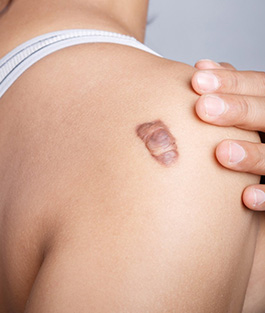
ScarDifferent Types of Scars
Scars are a natural part of the body’s healing process, usually resulting from injury, surgery or a skin condition such as acne. They vary depending on the size and depth of the wound, its location, and individual skin characteristics. Common types include hypertrophic scars, which are raised and remain within the boundary of the original injury; keloid scars, which extend beyond it; atrophic scars, which create depressions in the skin through loss of tissue; and stretch marks, which occur when skin stretches or shrinks quickly.
At The Skin Centre, the Dermatologists assess the type of scarring first, because different scars respond to different treatments. An accurate assessment is what allows treatment to be matched to the specific scar.
We have a range of technologies available for scar treatment, including the Cutera Excel V, CO2 laser and Nordlys Frax laser, each suited to different types of scarring.
Who Do Scars Affect?
Scars can affect anyone who has experienced a significant wound, surgery, or a skin condition such as acne. Most people have some scarring at some point, though how visible it is, and how much it affects a person, varies widely. Factors such as age, genetics, skin colour and location all play a part.
Scarring can affect more than appearance – it can have a real emotional impact – and we approach it as a medical concern, not only a cosmetic one. Our aim is to provide considered, individual care regardless of the type or severity of the scar.
Our Approach
We take a medical, individualised approach to scarring, grounded in assessing the specific type of scar before recommending any treatment. The Dermatologists who consult at The Skin Centre draw on a range of options (e.g. laser, skin needling and other treatments) matched to the diagnosis rather than applied uniformly.
We place a strong emphasis on patient education, so you understand the options available, what each involves, and what you can do to support healing. You’re involved in the decisions about your care, and no treatment goes ahead without your informed agreement.
Ways We Treat Scars
Because scars differ, there’s no single treatment that suits everyone. Depending on your assessment, options your Dermatologist may discuss include:
- Laser treatments — such as the CO2 laser for skin resurfacing, the Nordlys Frax laser, and the Pico laser, used to address the colour and texture of some scars.
- Subcision — techniques used for certain deeper or depressed scars, to modify scar tissue and support more even skin regeneration.
- Skin needling and RF microneedling — used to stimulate the skin’s natural repair processes and support collagen production, which may improve the appearance of some scars over time.
Which of these may be appropriate, alone or in combination, depends on your specific type of scar and skin, and is determined during your consultation. Some scars improve more than others, and your Dermatologist will discuss what you might reasonably expect.
*Important information
All cosmetic and medical procedures carry risks and may not be suitable for everyone. Cosmetic and medical treatments at The Skin Centre begin with a consultation, where your clinician will assess your skin, discuss the options that may be appropriate for you, and explain the risks, recovery and likely number of treatments involved. Not every consultation results in treatment. Individual results vary from person to person.
The information on these pages is general and does not constitute medical advice. Suitability, risks and expected outcomes are discussed during your consultation.